“Timelessness comes down to one question: Would this still matter in ten years?”
Founder of New Mountain Magazine talks about what makes a story timeless, edition two stories, gaining traction, the beauty of analog, and upcoming events.
Interviewed by Gracie Hinz
How do you decide what stories make it in the Mag? What makes a story feel “timeless” enough for print?
I usually begin with activities. I don’t want a magazine that’s just bikepacking, or just running, or just climbing. New Mountain is meant to be a collective — a mix of perspectives, sports, tones, and voices. So I ask myself: Do we have cycling? running? Something snow-related Something completely unexpected? Something quieter or emotional?
Then I think about format — interviews, photo essays, personal essays, trip reports, guides. I want someone to be able to pick it up and choose something that fits their mood.
Timelessness comes down to one question: Would this still matter in ten years? I strip away the social media lens. If a story only works as an Instagram trend, it doesn’t belong in print. But if it’s about place, friendship, grief, obsession, creativity, curiosity — the things that stay with you — then it fits.
Some pieces are epic expeditions; some are tiny, everyday moments. They just need to work beyond the news cycle.
Can you walk through a few stories in Issue Two that really capture that range?
One of my favorites is the opening story, Arctic Sisterhood. A group of women traveled to Svalbard to visit a friend who was working there as a teaching assistant. Some of them knew each other; others didn’t. Suddenly they’re in this wild Arctic landscape, carrying rifles for polar bear safety, sledding, exploring. None of them are professional photographers, but they shot these incredibly timeless images. It feels like it could’ve happened decades ago.
On the opposite end of the spectrum, there’s What My Mum Taught Me About Alpine Flowers, a photo essay from a guy in the Alps. It’s about spending time in the mountains with his mum, who was terminally ill. It’s tender, reflective, and speaks to the mountains as a healing space — not just a playground.
Then there’s Bjorn from Austria, who does off-road inline skating. Think rollerblades with fat inflatable tires, and then imagine skating down rough mountain tracks. It’s strange, brilliant, unexpected — exactly the kind of story I love including.
We’ve also got an excerpt from a book about crossing the Italian Alps on horseback, a field guide to campsite cooking, a piece from an expedition medic, and an interview with Gaby Thompson and Lael Wilcox about the Komoot Women’s Bikepacking Rallies. It really is everything from a huge adventure to “I could do this next weekend.”
What drew you to Gaby and Lael’s story?
I love what they’re building. The women’s bikepacking rallies intentionally lower the barrier to entry. They’re creating a space where women don’t have to be fast or hyper-experienced — they just have to show up. In the interview, they talk honestly about the challenges women face entering the bikepacking world: safety, confidence, gear anxiety, logistics. Their approach keeps things welcoming, joyful, and real, which feels very aligned with the magazine.
Chris Burkard is one of the big names in this issue. How did that collaboration happen?
He actually reached out to me, which still feels surreal. He messaged saying he liked the creative direction and asked if he could write something for Issue Two. I honestly thought it was a joke at first.
He ended up sending a deeply personal essay about moving from California to Iceland, confronting burnout, and re-centering his life around family and landscape. It’s not about a massive expedition — it’s about what happens when you shift your priorities. We paired it with his film photography: quiet, everyday images of kids, home, and the outdoors. It felt right to put him on the cover — not because he’s famous, but because he trusted a tiny indie magazine with a vulnerable story.
Covers always feel huge. How did you land on the Issue Two cover?
Covers are horrible — I lose sleep over them. Issue One’s messy boot photo set the tone, so Issue Two needed to feel connected. We chose an analog photo of Chris: tired, loaded with gear, boots slung around his neck, paddles in hand. It’s ambiguous — you don’t know the exact trip, but you know the feeling.
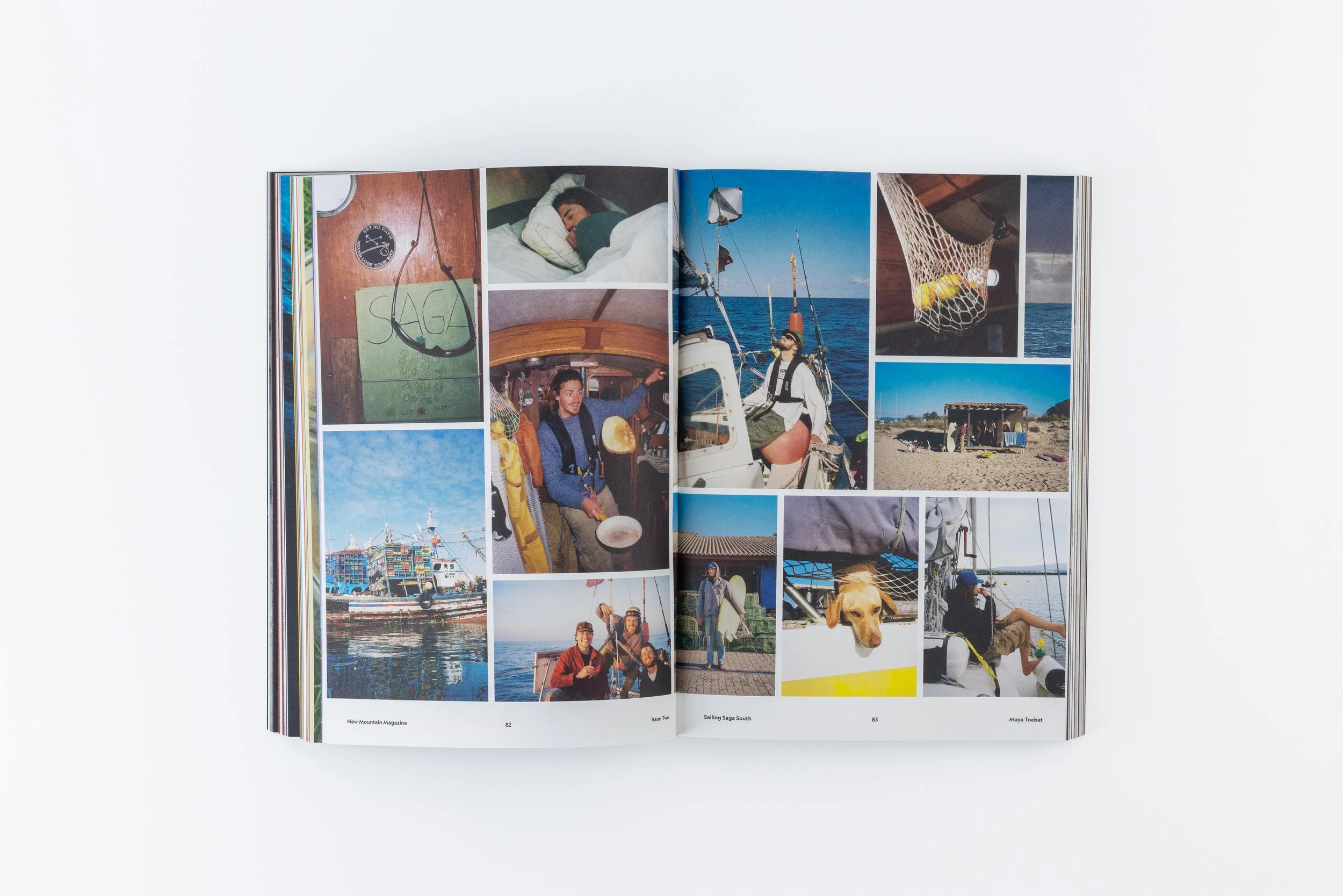
It also matches the visual language of the magazine. Probably half the imagery across both issues is shot on film. The warmth and texture of analog fits perfectly with the uncoated paper stock.
Speaking of analog — you have a lot of film photography in both issues. Is that intentional?
Very. Though I never explicitly asked for film, it’s become part of the magazine’s DNA. Film forces you to slow down. You can’t overshoot. It tends to feel more timeless. The only challenge is when someone sends an incredible low-resolution scan that I have to somehow make print-worthy — that’s when InDesign and I fight.
You also shifted to global distribution this time. How did that come together?
After Issue One, I was packing and shipping every copy by hand. Direct-to-customer is manageable until wholesale orders start coming in. Shipping 20 copies to Spain, navigating customs, scrambling for boxes that actually fit — it became a full-time job.
For Issue Two, I began working with a distributor. I print in Europe, and the magazines go directly from the printer to their warehouse. They handle shipping to stockists around the world and share new titles with their network. They take a cut, but it saves me an incredible amount of time and stress.
And you still ship some copies yourself. What’s been the hardest part of that?
Customs, easily. I’ll do everything correctly, and someone will still get charged a random fee at their door. Or entire batches get returned — Canada’s postal strike meant a pile of Issue Twos came straight back to me. Every order means a lot to me, so those moments really sting. I now have a mental list of “countries that are slightly cursed.”
How many shops are you in now?
Issue One made it into 12–15 shops. Issue Two is closer to 30 so far, mostly across the UK and Europe, with a few in Australia and New Zealand. There’s a map on the website with the full list, and it’s growing. I love seeing it in outdoor shops and indie magazine stores — places where people actually stop, browse, and discover.
You’ve got some in-person launch moments coming up too.
Yes — one at Centre Commercial Outdoor in Paris. We’ll have mags, snacks, and a few short films tied to Issue Two stories. Ride to Ride by Hena Pölsiari and Karin Ekman will screen, plus a short film with Bjorn skating in Iceland. It’s casual — more about gathering people who love stories, print, and being outside. I’ll also have a pop-up in Dorset and hope to appear at some film festivals this winter.
For people who loved Issue One, what would you say they’ll find in Issue Two?
It feels like returning to the same house — just with more rooms. Same aesthetic, same tone, still a mix of analog and digital. But bigger, more global, more confident. It’s not meant to be read straight through. It’s something you come back to again and again — Arctic snow, an Alpine meadow, a campsite stove, a weird little skate line. Moments you can sit with.
What’s next for you and for New Mountain?
I’ve already started Issue Three. I’d love to build the digital journal out — a space for stories that work better online or in video, and for bringing back some Issue One pieces now that it’s sold out. Longer-term, I’d love to create a small film festival under the New Mountain umbrella — thoughtful, human, under-the-radar stories.
Order a copy of New Mountian here.
Listen to this interview.