“This race isn’t about me or Cam. It’s about a team and community racing a World Cup in the U.S.”
Cam and Anna talk about what it means to race the final Olympic skimo qualifier on home snow, the leap from trail running into skimo, the pressure and possibility of a World Cup relay, and how years of preparation and a last minute partnership have brought them to this moment.
Interviewed by Gracie Hinz
GRACIE:
Jumping straight into it, I’d love to give people an overview of who both of you are and what brings you here to Solitude. Cam, take it away, who are you, and what do you spend your time doing?
CAM:
I’m Cam, and I spend most of my time training for and racing skimo events. We’re here at the World Cup in Solitude, Utah, which is the first World Cup in the US in twenty years. It’s also the first race of the 2025–26 season and the final race of the Olympic qualifying window.
ANNA:
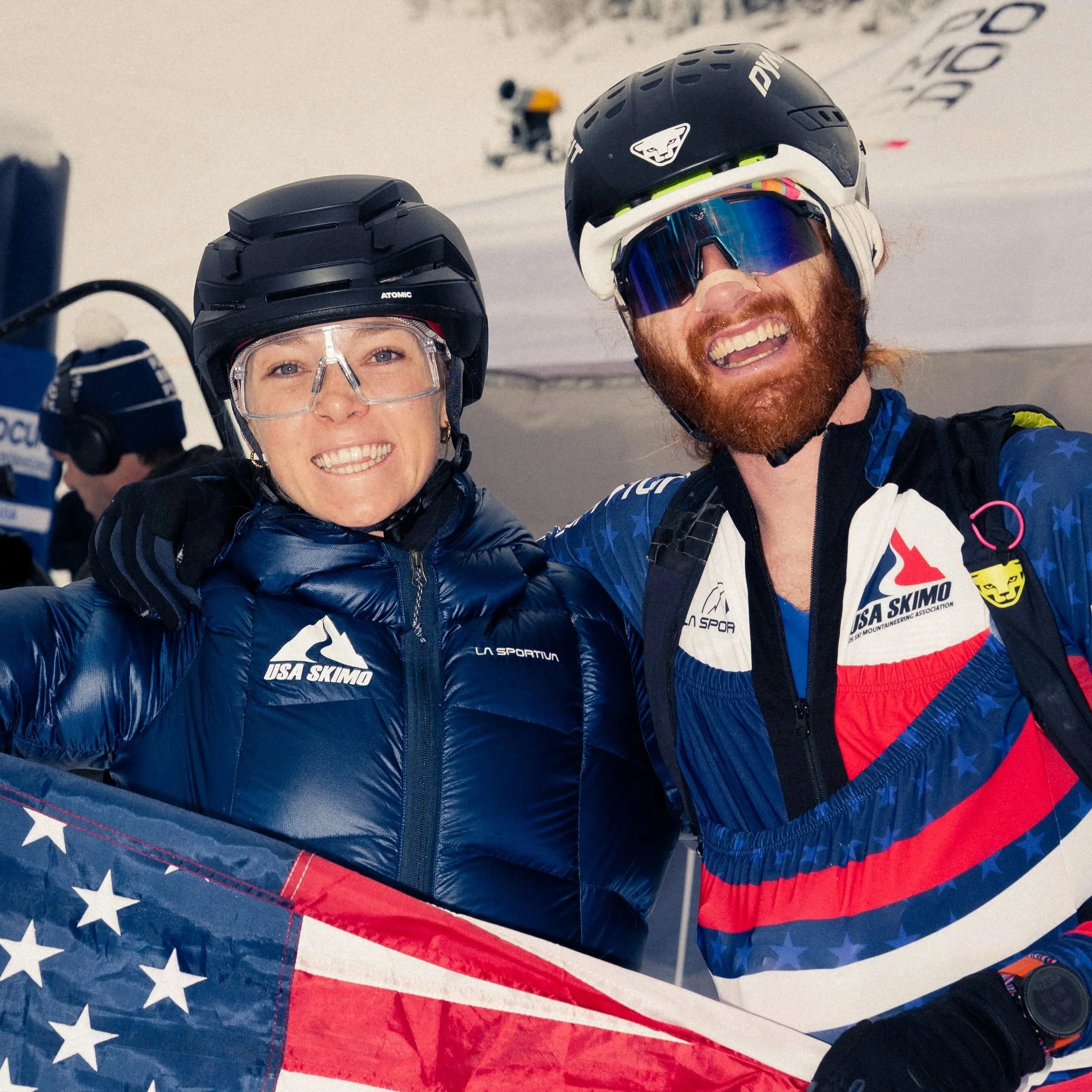
I’m Anna, and I’m Cam’s relay partner for this race. I’m new to skimo, which has been really fun, but I’m not new to skiing. I’ve competed in a lot of disciplines over the years and it has been cool to take skills from all these different spaces and put them together in a new environment.
Gracie:
Both of you have strong trail running backgrounds too. People probably know your names from other places and now they get to see you in skimo. But Cam, you’ve been racing on the skimo World Cup circuit for a while, right?
CAM:
My first international race was the world championships in 2017. I was still U23 then, which is the only reason I could go. I wouldn’t have qualified otherwise. I’ve raced every year since, so this is maybe my eighth or ninth year.
GRACIE:
What was your entry point into skimo?
CAM:
I started with the Grand Traverse, the race from Crested Butte to Aspen. It’s way different from World Cup racing, but it introduced me to the gear and the community. Then I found all the local events in Crested Butte where I lived and went to college. We had weeknight races and everything was just fun. I was hooked on both the two minute sprints and the six hour races. Since then, I’ve just been chipping away at getting better, and really focusing on the Olympic disciplines the last two years.
GRACIE:
When was it announced that skimo would be an Olympic sport?
CAM:
In June of 2021, before the Beijing Games. The International Olympic Committee (IOC) had recommended it earlier, but the host nation gets final say on new sports. China didn’t want to add it since they had limited development in the sport, so it didn’t go into the 2022 Games. The next year, in 2023, it was finalized for 2026.
GRACIE:
Can you describe the Olympic skimo formats for people?
CAM:
Skimo has five main events. The sprint and relay are the Olympic ones. There’s also vertical, which is only uphill, individual, which is a classic multiple climb and descent race, and the team race which is a longer version of the individual done side by side with a partner.
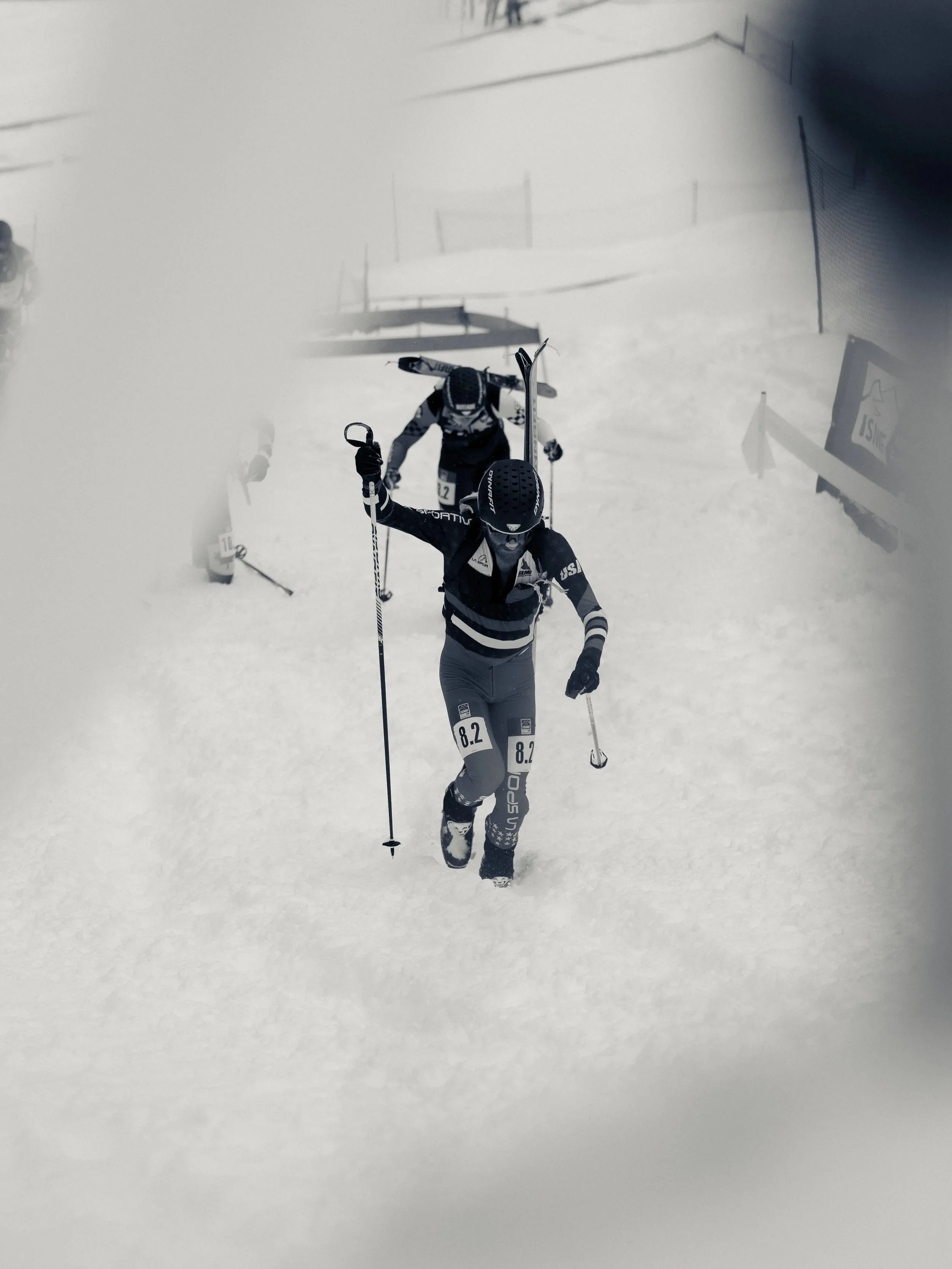
For the relay, which Anna and I are doing, the course has two climbs and two descents with a final skin-on transition. Anna goes first, then tags me, then we repeat that sequence until we’ve each done two laps. Each leg is seven to ten minutes with a ton of transitions. The sprint is the shortest event in the sport and takes about two to three minutes.
GRACIE:
Anna, how have you been prepping for this?
ANNA:
Prep has definitely been unusual because it has been such a dry year in the western US. Many of us haven’t had much time on snow, so we’ve been doing a lot of cross training and practicing transitions inside or on tiny patches of snow. I tried to extend the fitness from my running season, then move my workouts to the bike or skis whenever possible. And I’ve practiced transitions nonstop. If you’re even one second slower every time you transition than someone else, and your fitness is similar, it adds up fast.
GRACIE:
Has it been a wake up, practice transitions, repeat?
ANNA:
Actually the opposite. I practice transitions at the end of the day because in a race you’re exhausted and trying to think clearly while breathing hard. I want to mimic that. So I do them after training or after a mentally tiring day. It has been a helpful little mental challenge.
GRACIE:
And how did you get to this point where you’re on the relay team?
ANNA:
We should start with how I even ended up here. Cam has known about the Olympics being his goal for years. I had not been thinking about skimo at all. I remember when it was announced because I follow the sport, but it wasn’t on my personal radar as something to pursue.
Then in June at Broken Arrow, we were both racing trail, and Cam walked up to me at the finish and said, “You can tell me no and I’ll never bring this up again, but do you want to try getting on the US skimo team and see if you could contribute to the relay, maybe even make the Olympics?”
I was like, the answer isn’t no, but that feels so far fetched. There’s so much to learn about the sport. But after a few weeks of talking, connecting with staff, and understanding the pathway, I realized it was actually feasible. I decided to go all in as a side project while still focusing on trail through this past October.
CAM:
From my side, six of the seven qualifying events had already happened and this is the last one. Our entire Olympic relay qualification comes down to this one race. I was thinking about who else we could bring onto the team, and the ideal person would be a world class uphill runner, a strong competitor with maybe a track background, someone with skiing experience, calm under pressure, adaptable, quick to learn new skills, and someone used to racing in different sports. That was Anna.
All summer we had training camps, mostly dryland, a few on snow. Then two weeks ago we had internal time trials. We took everyone on the Olympic list plus a few invitees, including Anna, and raced a mixed relay course. We chose the fastest male and fastest female. That is how we became the team for this World Cup.
GRACIE:
Cam, how has the Olympics been on your mind these last years?
CAM:
It has felt so far off for so long. Saying 2026 in 2022 felt unreal. But the sport has changed dramatically. There’s more professionalization, more youth development, more federation support, more media interest. Once something becomes an Olympic sport, everything shifts.
Personally, it has been a long term beacon. My phone password has literally been 2626 for years. I’ll change it once this goes out. I stopped running ultras, shifted to shorter summer races, spent more time in the gym, dialed in details, and prepared in ways that I hoped would matter when the moment arrived. Now we are two days away from that moment.
GRACIE:
What are you most excited about this weekend?
ANNA:
Just being part of this so immediately and so fully. I dove straight into the deep end of this sport and already feel incredibly welcomed by the US skimo team. It is cool to show up to something this big and feel like part of it right away. And knowing that this race isn’t about me or about Cam, but about a team and a community that has pushed this sport forward for so long makes it even more special. Having a World Cup in the US, and having it determine our winter, is incredible. I’m excited to take in the whole scene.
CAM:
I’m excited for the culmination of everything we have built as a group. Dozens of teammates and coaches, plus all the supporters, families, and communities. That circle grows into the thousands. I’m honored to be the one carrying the baton. Whether we hit the exact qualification goal or not, being in the fight is what matters. And honestly, Anna and I are probably the least nervous people involved. Everyone else is worrying for us, and we’re just excited to go out and race.
GRACIE:
It’s also amazing that this is happening in the US. Was it intentional that this race would be the last Olympic opportunity?
CAM:
Not at all. The qualification pathway required six relays, and six had already taken place. A seventh was scheduled in France, but France decided not to host because hosting a World Cup is extremely expensive and they didn’t need the race for their qualification. The ISMF asked who wanted to take it on. No one volunteered.
Meanwhile the US was one point behind Canada. If the race didn’t happen, we would lose our chance. If it did happen, it would be a head to head. So the US raised their hand. Our federation, especially Sarah Cookler, did an enormous amount of work and fundraising to make it possible. All the nations agreed to come, and here we are.
GRACIE:
That’s incredible.
CAM:
Yeah, and you could see it as pressure or you could see it as a sign of how much people care. They created this opportunity for us. Our job is simple in comparison. We line up and race.
FULL INTERVIEW BELOW & THE WHOLE RACE SHOT ON SUPER 8 BY SOPHIA HINZ